Approaching 50 Years of Adventure for All
For nearly five decades, Wilderness Inquiry has been breaking down barriers — both real and perceived — to connect people from all walks of life to the natural world and to each other. Our story is one of innovation, community, and the unshakable belief in the transformative power of shared outdoor adventures.
Explore our journey decade-by-decade to see how a simple tipi on the edge of the Boundary Waters in northern Minnesota grew into a national movement for inclusive outdoor learning and adventure.
The 1970s:
An Idea Takes Root
The 1970s were a time of passion and purpose. Amidst national conversations about disability rights and environmental preservation for Minnesota’s Boundary Waters Canoe Area Wilderness (BWCAW), a powerful idea was born. It started with a shared tipi, a desire to include everyone in outdoor adventures, and a “crazy idea” for a new kind of wilderness trip that would expand the world of outdoor adventure forever.
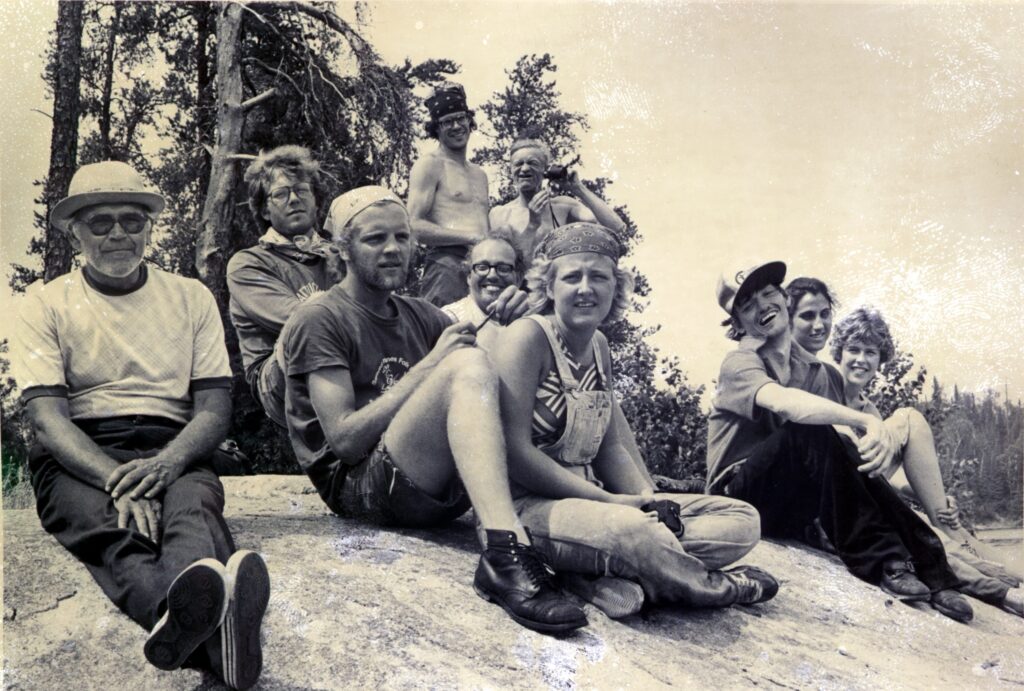
It all began when a group of 16 people, including our founder Greg Lais, cooperatively purchased a property with a large, distinctive tipi-shaped cabin on Farm Lake, right on the edge of the BWCAW. This tipi became the heart of our early adventures and a gathering place for the community of people that would build Wilderness Inquiry. It was here that early partnerships formed, laying the groundwork for our future.
In response to politicians’ unfounded claims that a motor-free BWCAW would exclude people with disabilities from enjoying the area, Greg Lais and his friend, Paul Schurke, planned the first-of-its-kind integrated wilderness adventure. They guided a group that included two people with paraplegia and two people who were deaf on a 10-day canoe trip into the stunning Lac La Croix region of the Boundary Waters, proving that with a little creativity, tenacity, and cooperation, the wilderness could truly be for all people to enjoy. This foundational journey sparked everything that was to come.
With a growing community of support, our founder Greg Lais officially incorporated “Wilderness Inquiry II” as a nonprofit organization on May 5, 1978. Operating on a shoestring budget with support from initial funders, we served 38 people in our first year. It was the official start of a mission to bring people together in the wilderness. Support from our initial funders — the Bayport Foundation, Northwestern Bell, the Wax Museum and Hunt’s Bus Company — allowed us to buy four canoes, several canvas packs, and tents.
The 1980s:
Growing an Inclusive Model
With our mission established, the 1980s were a decade of rapid growth and refinement. We learned valuable lessons from the field and began building replicable models for inclusion. We also developed groundbreaking adaptive equipment, expanded our reach from winter dog sledding to international adventures, and truly defined what it means to create a community for everyone in the outdoors.
To ensure everyone could travel comfortably in all seasons, we pioneered new adaptive equipment through partnerships. We worked with Honeywell engineers using “CAD-CAM” technology to design our first pulk sleds, and with Gillette Children’s Hospital to create an innovative sling seat for canoes and the versatile “People Pack.” Our spirit of adventure led us to the Yukon, where we led our first integrated trip down the Big Salmon River, an epic journey that started at Quiet Lake in the Big Salmon Range and finished in the historic Klondike Gold Rush town of Dawson.
Our spirit of adventure knew no bounds! After leading several winter dog sledding trips in Minnesota, Paul Schurke joined Will Steger and Ann Bancroft on the first confirmed dogsled journey to the North Pole without resupply. This incredible expedition solidified our reputation for world-class adventures and brought team members like Ann Bancroft — who would become the first woman to reach both poles — into the Wilderness Inquiry family.
How do you ensure everyone truly belongs on an adventure? Greg Lais answered that question by developing the “Seven Steps to Full Participation,” which was published in Indiana University’s Bradford Papers. This framework became our guiding star for fostering meaningful inclusion and social connection on every trip. It was a pioneering model that influenced outdoor leadership programs across the country.
The 1990s:
Designing for Inclusion & Building to Last
The 1990s were about building for the future. We formalized our systems, innovated new ways to adventure together, and established our first permanent home. From designing our iconic big canoes to forging partnerships with federal agencies, this decade was dedicated to creating a strong, sustainable foundation that would allow us to serve more people in more impactful ways.
To bring more people out on the water together, Greg Lais worked with boat designer Al Gustaveson to build our first 24-foot, 10-person North canoe. These beautiful cedar-strip canoes weren’t just boats; they were floating classrooms and vehicles for creating an inclusive community. Originally designed for big water expeditions on Lake Superior and Lake Nipigon, they became a critical component of our programming, allowing larger, diverse groups of urban youth and families to experience their local waterways together.
With support from the U.S. Department of Education, we launched a program called “Families Integrating Together” (Project FIT) in response to the desire of people experiencing disability to travel with other members of their family. Still a core part of our work today, our family adventures provide accessible, multi-generational opportunities for families and kinfolk to experience the connective power of nature together.
We continued to innovate, creating adaptive gear like the “Sling Seat” with support from Gillette Children’s Hospital. Greg Lais also worked with Joe Meade of the U.S. Forest Service to create the “Wilderness Access Decision Tool,” a guide that was presented at the Santa Fe Wilderness Conference to help federal land managers make informed decisions about accessibility in our nation’s wild places. These efforts, combined with our first rafting trip in the Grand Canyon led by Kath Sharp, pushed the boundaries of what was possible.
With strategic leadership from Sarah Milligan-Toffler, our budget exceeded $1 million for the first time. In addition to completing our first strategic plan and establishing partnerships with more than 60 organizations, endowments like the Finch Family Endowment helped secure our future. This organizational stability allowed us to launch a statewide trail accessibility survey and formalize our development efforts, solidifying our role as a leader in the field of accessible outdoor adventure travel.
The success of Wilderness Inquiry’s capital campaign allowed us to purchase and renovate our first permanent headquarters in Minneapolis’ Dinkytown neighborhood. With a ground-level warehouse and close proximity to University of Minnesota students to recruit trail staff, it was a dream come true. We also purchased “Martha’s Place,” a staff house named for inspirational participant Martha Finch, finally giving our trail staff a home base to land between trips and to build community amongst our Outdoor Leaders.
The 2000s:
Achieving Stability & Scaling Innovation
This decade brought both significant challenges and incredible growth. We weathered economic downturns with resilience, strengthened by the unwavering support of our community. We solidified our philosophy, invented new adaptive equipment, launched our Canoemobile program, and established a permanent base camp near the Apostle Islands National Lakeshore, emerging as one of the premier accessible outdoor organizations in the nation.
How can a wheelchair user navigate a rugged hiking trail? We invented a solution! The “Wilderness Rickshaw,” a purpose-built piece of adaptive equipment developed by Greg Lais, uses a pole-and-harness system to attach the front of a wheelchair to a hiker. This simple, effective invention made a much wider variety of trails accessible, allowing more people to experience the joy of hiking and other outdoor adventures near and far.
We celebrated our 25th anniversary with a party in our warehouse, featuring a surprise guest: former Minnesota Governor Wendell Anderson. In 1977, he claimed that removing motors from the BWCAW would exclude people with disabilities — giving rise to our founding trip. At our party, he graciously acknowledged that the birth and growth of Wilderness Inquiry was one of the best, if unintended, outcomes of his administration — a full-circle moment for our mission.
We put down roots in one of the most beautiful places in the Midwest: the Apostle Islands National Lakeshore. We purchased 40 acres near Little Sand Bay and began developing a beautiful, universally designed base camp. This camp provides comfortable, accessible group camping and serves as a welcoming hub for people of all abilities to explore the magic of Lake Superior. Minnesota-based Wenonah Canoes eventually becomes a valued partner in building accessible sea kayaks that are used exclusively for our adventures.
In partnership with the National Park Service, we launched the Urban Wilderness Canoe Adventures (UWCA) program. We loaded our 10-person canoes onto a trailer and hit the road, offering free, guided paddling experiences for thousands of youth on the Mississippi River. The program, which would eventually be renamed Canoemobile, quickly became our flagship model for place-based education, connecting kids to nature in their own backyards.
The 2010s:
Finding Our Stride with National Engagement
In the 2010s, we hit our stride, scaling our impact across the country while deepening our community roots. Canoemobile expanded from coast-to-coast, we formalized our educational models, and we created pathways for the next generation of outdoor leaders. We celebrated huge milestones, from burning our mortgage to serving half a million people.
We developed a clear logic model to illustrate our vision: the “Pyramid of Outdoor Engagement.” It shows how a meaningful progression of introductory experiences like Canoemobile can lead to deeper, transformative wilderness adventures. That same year, we hosted our first Great River Race on the Mississippi River, a beloved community event, and partnered with the Okee Dokee Brothers, who went on to win a “Best Children’s Album” Grammy, for their canoe trip-inspired songs.
Working with Minneapolis Public Schools, we introduced an innovative solution for high school students to engage in place-based, experiential programs to recover missing academic credits. Outdoor Credit Recovery was one natural outgrowth of prior programming that we developed to teach outdoor leadership skills through student cohorts including our Adventure Leadership Program in 2005 and Outdoor Career Academy that also emerged later in this decade.
To build a more inclusive outdoors, we launched the Outdoor Career Academy to prepare youth for professional roles in the industry. That same year, we officially rebranded our traveling program as Canoemobile and, thanks to the “Burn the Mortgage” campaign, we became debt-free for the first time in 15 years, ensuring financial stability for the future. Our international trip offerings expanded to new locations and proved to be a positive social enterprise that would bolster financial support for other programs while also engaging a broader community in trips for people with and without disabilities.
For our 40th anniversary, we achieved the bold goal of serving 40,000 people in one year, reaching a cumulative milestone of 500,000 people served since 1978! To sustain that growth, we partnered again with Wenonah Canoe to build a new fleet of our 10-person canoes from modern composite materials, making them lighter and more durable for the adventures ahead.
The 2020s:
A New Chapter of Resilience and Growth
The 2020s brought unprecedented challenges and exciting new beginnings. We navigated a global pandemic with creativity, welcomed new leadership, and found a new permanent home. This decade is defined by our resilience and a renewed strategic focus on welcoming even more people into the Wilderness Inquiry community.
After 42 years at the stern, founder Greg Lais retired just before the COVID-19 pandemic began. The organization, under the leadership of Interim Executive Director Kim Keprios, pivoted with incredible speed. We launched “Virtual Explorers,” an innovative online program that brought environmental education and a sense of adventure to thousands of schoolchildren learning from home.
Following a period of steady leadership through the pandemic, the Board of Directors hired Erika Rivers as our new Executive Director. With new leadership at the helm and our finances secured by the sale of our longtime headquarters, we embarked on a strategic planning process to chart the course for Wilderness Inquiry’s future.
In partnership with Blue Star Families, we launched our Military Families Outdoors program, providing welcoming outdoor adventures to support the health and wellness of active-duty military families. We also purchased and began renovating a new headquarters in Bloomington, MN. Our new headquarters is a space designed for community, collaboration, and outfitting a new generation of adventurers, and marks the start of our next chapter, poised for growth and ready to share outdoor adventures for the next 50 years!