
Tucked into Dinkytown’s urban landscape is a distinctly Minnesotan institution. Wilderness Inquiry has been introducing individuals to the outdoors for over forty years. Its office and warehouse are easy to miss, except when rigs of Voyager canoes emerge from the parking lot and rumble down the city streets. It is obvious that these are not just ordinary canoes. Measuring at an impressive twenty-four feet, their varnished wood shines. Handcrafted, they evoke a bygone era with names such as the Hastings, the Itasca, and the New Orleans. You might assume the rigs were headed for the Mississippi or the Boundary Waters, but these canoes venture much farther than that.
Each spring and autumn, Wilderness Inquiry sends out multiple rigs of Voyager canoes as part of its Canoemobile program. Canoemobile connects individuals with their local waterways by combining environmental education with an introduction to accessible water-based recreation.
Each tour starts well before the canoes are loaded. Wilderness Inquiry works with a long list of partners including governmental  organizations, school districts, and local non-profits. Most of Canoemobile’s partners return year after year. Open Canoemobile slots are rare. After the permits have been pulled and staff reservations made, the rig crew meets for a series of trip planning sessions that culminate in the “pack out.” Canoemobile staff members are seasoned guides, that know the value of doing things by the numbers. At pack out, everything is counted and checked: 308 rain ponchos, 139 personal flotation devices, 81 paddles, 25 winter hats and mittens, 16 step stools, all the way down to the one garden hose. There are 71 categories to check off the gear list. Everything is packed in and strapped down in accordance with WI’s set procedure. Preparation, organization, and safety are incorporated into the routine even before the van leaves the parking lot.
The excitement of heading off on a new tour quickly dissolves into a state count along the long snow-free route. Minnesota, Iowa, Missouri, Kansas, Oklahoma, Texas, New Mexico, and Arizona all get checked off the list before reaching the California border. A minor jubilation erupts as the van crosses into the coastal state. Soon after, the crew groans as traffic slows to a glacial pace. After nine states traveled in a packed van, the guides are eager to start programming and to drop the canoes in the Pacific. Yet even while idling in the relentless LA basin traffic, the Voyager canoes spark people’s curiosity. Canoemobile is selling itself. Questions get asked and brochures get passed through open windows. There is just something about those beautiful, wooden canoes.
 After an inaugural 2019 spring tour stop in Santa Barbara, the crew arrives at the Cosumnes River Preserve for a week of programming with Galt Schools. Tents go up so quickly that it is hard to believe they are the same kinds that confound family campers. The crew makes dinner and then sits down to plan and review roles for the next day’s program. While many programming days look the same on paper, each one brings its own set of challenges. For the next month, they will be firmly entrenched in the Canoemobile routine.
On a typical Canoemobile day, there are two non-negotiable morning items: coffee and orange juice. The combination seems to help everyone into the van. By 7:00 am, Canoemobile is in place and ready for programming. As the clock strikes seven, the first two canoes are dropped. This sounds so easy. How hard can it be to drop a canoe? Given that the canoes range from 350-500 pounds, dropping is definitely a core exercise. Wooden canoes, just like people, often pack on the pounds as they age. A little epoxy here and a little there just adds up. Before you know it, that canoe is destined for the bottom spot on the rack. In just the first half of the Canoemobile tour, the crew performs roughly 200 boat lifts. Conservatively, that is 80,000 pounds of on again off again.
After the first two boats, the staff splits to meet with local partners, to coordinate scheduling of buses, and to unload the gear. All gear is  placed on tarps. Paddles are neatly lined and pointing in the same direction. PFDs are stacked into four groupings of yellow, blue, red, and type 1. Wilderness Inquiry has always embraced inclusive outdoor experiences and Canoemobile is no exception. Why the perfect rows when piles would do? The attention shown to small details reflects the professionalism of the Canoemobile staff. Water-based education is not a safety norm for most school districts. The visual organization helps to instill confidence amongst arriving administrators, educators, and participants. The final four boats are then dropped and it is show time.
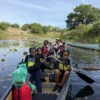
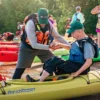
The buses arrive, the bus doors open, and bundles of energy climb down the steps. While the largest numbers of participants are from school districts, Canoemobile programs for a wide variety of groups. Whether participants are fifth graders, high school students, or adults with disabilities, Canoemobile enriches equally. The group gathers in a circle and get a quick introduction to WI, their boat captains, and the idea that wilderness can be found in their own backyards. In groups of nine, participants meet with their boat captain to learn the paddle stroke and the three rules. Always listen to your boat captain. PFDs must be zipped and clipped. Move in and out of the boat low and slow. The paddlers are ready and the air is filled with nervous laughter as they head to the boats.

For most participants, this is their first time in and canoe. For many, this is their first time in a boat. Yet as they settle into their seats, they start to relax and the smiles emerge. Each day, a canoe will typically take three or four groups out on the water. The west coast portion of this year’s Canoemobile included 33 programming days. How many smiles are there on a tour? Well, it is hard to calculate smiles, especially as some participants never stop smiling. Is that just one smile? Nonetheless, the smiles easily reach the thousands. Canoemobile illustrates how learning and pleasure can coexist.
Each trip is an adventure. At the water level, participants see their local environment from a new perspective. Students paddling under interstate 5 observe swallows building nests. “How does this bridge impact animal behavior?” “How do human-made structures impact the ecology of an area?” Occasionally the discussion digresses to “How fast do you think we can paddle?” However, what is important is that participants are enjoying new intellectual and emotional connections with the world around them. A little wilderness is a healthy thing.
 As the afternoon wears on, the last bus leaves. You might think this is the end of the day. Not yet. If the canoes are traveling to a new body of water, then everything needs to be washed. There are no environmental hitchhikers on Canoemobile. Programming days are a seemingly unending cycle of set up, wash up, and pack up. Now if you are thinking how lucky the crew is to work away from a desk, well there is still a lot of paperwork. There are binders full of forms for things like expenses, van and trailer checks, partner information, participant waivers, and boat condition reports. Finally the tasks are completed and, once again, the Itasca, the Minnesota, the New Orleans, the Hastings, the Paul Adelman, and the Finch Family are lifted onto the racks.
As Canoemobile drives away from the programming site, the crew is hungry and ready to eat. Dinner is made and they start their daily debrief. WI uses a version of the Plus/Delta assessment tool. They start with the praise. What went right during the day’s programming? Perhaps there was a sensitive situation that was handled well or a day of, particularly efficient dock management. After the good news, it is time to pick apart what did not go well and how the team can address these issues. After debriefing, the crew works on the next day’s plan and assignments. Finally, they shuffle off to bed. Each guide enjoys a few minutes to listen to a few tunes or read. However, the lights go out quickly. In just a short few hours it will again be time to make the coffee, pour the orange juice, and pile into the van.
Canoemobile works every day with roughly one day off every two weeks. This is a hard-working bunch. Staffing this Canoemobile tour are Sam, Cory, and Claire from Minnesota. Katie from Pennsylvania and Matt is from Ohio. Angie is from Wisconsin, Mary is from Massachusetts, and Peter is from Idaho. While the crew hails from many different states, there is a genuine sense of Minnesota nice. Even after the long drives, hours of programming, and the occasional bump in the road, they keep on smiling. Not only are they kind, but they are also smart. They know that when the only privacy is your own tent, nice goes a long way.
After a month of programming in four Californian cities, Canoemobile spends a week in Salt Lake City, paddling on the Jordan River and Lake Utah. Canoemobile then heads back to Minneapolis. Late at night, the van pulls up to Martha’s Place, named in honor of outdoor enthusiast Martha Finch. Martha’s Place provides housing for WI’s staff and is their home away from home. For a few days, they will be free to do laundry, check in with family, sleep, and probably pay a few bills. How will the second half of Canoemobile’s “coast to coast” tour unfold? Well you can always find out by checking in with them on social media. Knowing this group, they will drive, lift, and paddle their way to New York City with the same professionalism and attention to detail.
It is impressive to see how this group tackles the details of touring. However, the nuts and bolts only lay the foundation for the important work of the Canoemobile crew. Not even counting the smiles, the documented outcomes of the program are impressive. How, on a simple field trip, do they forge such meaningful connections for participants? Well, the answer may be in a combination of Wilderness Inquiry’s staffing and expertise. After forty years of getting people outside, they know how to make an impact. Those beautiful canoes draw people in, but it is the experience they will not forget.