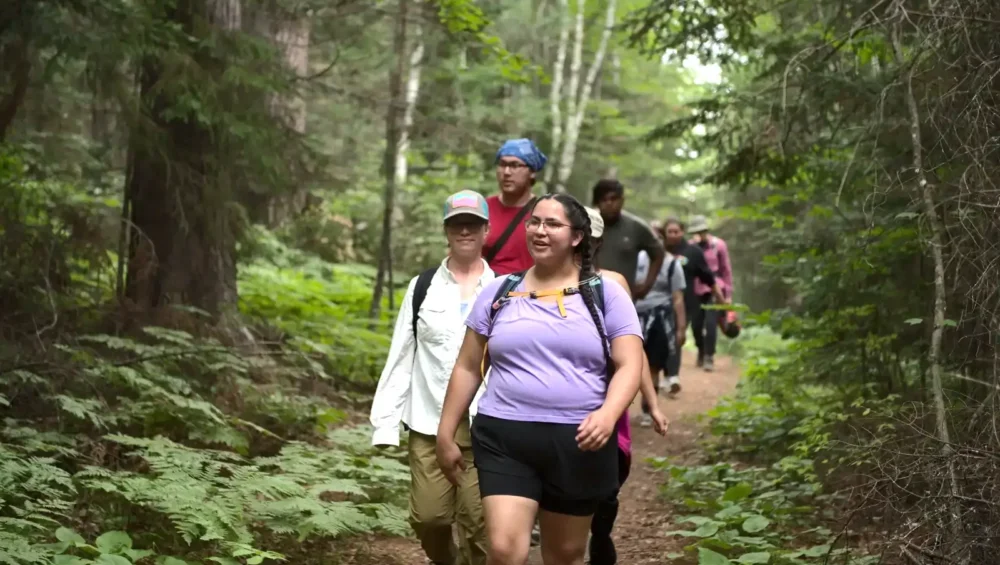
By Erika Rivers
On an August day in 2019, I came home from work wound tight.
I love my work, but that day had been one challenge after another. By late afternoon my shoulders were up by my ears, my head was buzzing, and I could already tell I would drag that feeling into the evening with my family.
Instead of just pushing through, I decided to intentionally slow down and run a little experiment on myself.
First, I took my blood pressure when I got home. The numbers were higher than my “normal.” I threw on some walking shoes and headed outside for a favorite small joy: searching for monarch butterfly caterpillars on neighborhood milkweed plants.
For about 30 minutes, I walked down the block, slowed my pace, and gently turned over leaves. I scanned for tiny white eggs, brightly striped caterpillars, and chrysalises hiding under the green. I noticed the angle of the sun. The sound of singing birds. The feel of warm air on my skin.
Then I walked back home and took my blood pressure again.
My top number (systolic) had dropped by 16 points. My bottom number (diastolic) had dropped by 21.
All I had done was walk through the neighborhood, immerse myself among a few plants, and let myself wander around outside for half an hour.
Life really is better when you spend a little time outdoors.
My single data point from 2019 is just one short story. But today, there are now hundreds of scientific studies from all over the world that are saying the same thing: spending time in nature is not just “nice.” It is deeply connected to our mental health, our physical health, and how connected we feel to other people in our lives.
And the amount of time we spend outdoors matters. Studying how time outdoors affects our health and well-being is called “nature dosing.” At Wilderness Inquiry, we have intentionally built our outdoor programming around a progressive set of experiences so our participants can get those “doses” in ways that feel realistic, supported, and welcoming for many different bodies and backgrounds.
What is “nature dosing”?
When you hear the word “dose,” you likely think of medicine.
Nature dosing is a simple idea: instead of thinking about time outside as random or “whenever I can get to it,” we can actually think about it like a health habit. How often you go outside, for how long, and how natural the setting is can change how your body and mind feel.
May is Mental Health Awareness Month, which makes it a good time to ask a basic question:
What if one of the everyday tools for feeling a little calmer, more focused, and more connected has been right outside our doors this whole time?
Researchers looking at parks, forests, lakes, and other green and blue spaces find that:
- Time in nature can lower stress hormones like cortisol and reduce blood pressure.
- Being outside can ease symptoms of anxiety and depression.
- Even short walks in natural settings can help our brains reset so we can focus and think more clearly.
- People who spend time in green spaces often move their bodies more, sleep better, and report higher life satisfaction.
You do not have to understand every study to know this in your own life. Many of us have had that feeling of walking into a park or along a river and realizing, “Oh. I can breathe again.”
And here is the really good news: the “dose” doesn’t have to be huge.
Some research suggests that around 120 minutes a week in nature is a powerful benchmark for better health and well‑being. Other studies show that even 10–20 minutes outside—a short walk, sitting under a tree, listening to water—can make a real difference in mood and stress.
Small, steady doses add up. And, deeper, immersive experiences have other benefits.
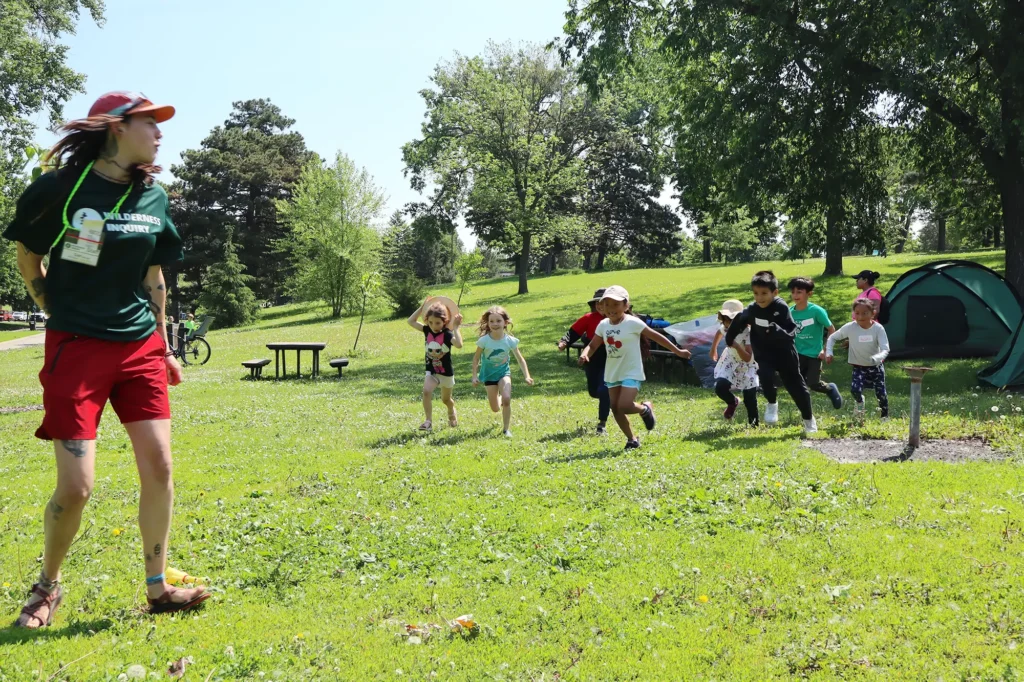
Quick dose to deep adventure: Wilderness Inquiry’s Pyramid of Outdoor Engagement
At Wilderness Inquiry, we see the power of nature dosing in every season of the year.
People come on trips for many reasons: to try something new, to connect with family or friends, to support a young person in their life, to find a break from screens and the constant noise of our daily lives, or to simply remember what it feels like to look up at a big sky full of stars.
We also know that not everyone starts in the same place. Some people already hike or paddle often. Others have never camped, have a mobility constraint, are caring for kids or elders, or have otherwise felt like the outdoors was “not for people like me.”
That’s why Wilderness Inquiry developed our program structure around what we call the Pyramid of Outdoor Engagement.
You can imagine it as a guided pathway into nature—from backyard to backcountry:
- Day programs
These are close to home and often short: a community paddle along a river in the city, a paddle on a local lake, a few hours building outdoor skills in a nearby park—hiking, snowshoeing, or skiing. They are the low-barrier “doses” it’s easy to say yes to, especially if you are busy, nervous, or unsure what you need to succeed. - Near nature overnight experiences
These are the middle layer: camping in a state or regional park; a one‑or two‑night river trip; a weekend hiking or backpacking experience. Here, people begin to unplug more fully. They share meals, stories, and quiet nights outside. Many participants tell us this is where they start to feel a deep shift in how they see themselves and other members of their group. - Extended and backcountry adventures
These are the longer journeys: Boundary Waters canoe expeditions, national park group trips, multi‑day paddling and hiking adventures. With our guides and support systems, travelers of many ages and abilities can experience these “big” adventures in a way that feels safe enough to try, not like a test of toughness.
The Pyramid of Outdoor Engagement is built on a simple belief: everyone deserves a real relationship with the outdoors, and that relationship can grow over time.
Nature dosing matches this approach:
- Our “backyard” doses help participants settle their nervous systems, experience deeper presence with a surrounding natural setting, and calm their minds enough to refocus in their everyday lives—often beginning to see the possible where they previously perceived the impossible.
- Our “near nature” and “backcountry” doses give participants longer stretches of time for stress levels to drop, friendships and connections to grow, and participants to see themselves and others in a new light.
You do not have to choose one or the other. In fact, the science and our experience both say that the mix matters: shorter, frequent time outside plus occasional deeper trips can be a powerful combination for mental health and overall well-being.
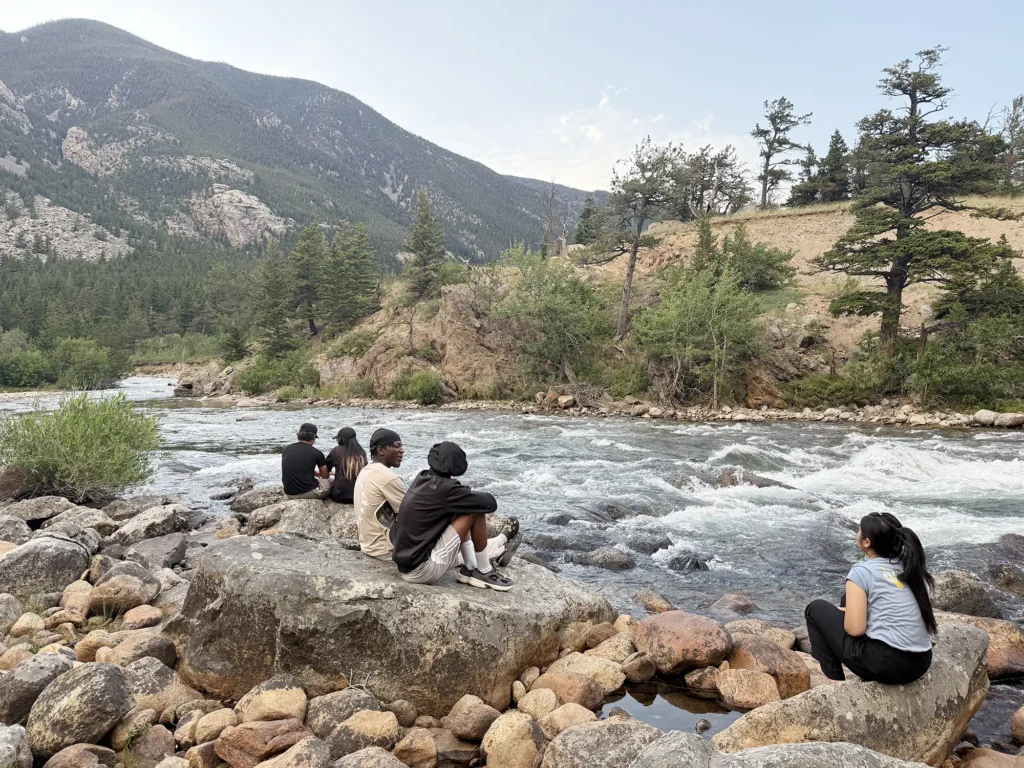
Nature as part of the mental health toolkit
Mental health is complex. Counseling, medications, support groups, spiritual practices, and community programs are all part of the therapeutic mix. Nature is not a cure‑all, and it should never be the only thing offered when someone is struggling.
But adding nature can help:
- A short walk in a park after a tough meeting.
- Sitting beside a lake and listening to waves for 10 minutes.
- Watching birds or the flow of a river from an accessible overlook.
- A weekend camping trip where you can talk quietly across a campfire or marvel at a night sky filled with stars.
These are not “extras.” They are practical, whole-body ways to tell our nervous systems, “you can stand down now.”
For young people and families, time outside also brings something else: connection. We see it on every trip. When you are paddling a canoe, cooking together, or laughing in the rain, people talk, share, and support each other in ways that are harder to reach in busy, indoor life.
For people experiencing disability, under‑resourced youth, military families, and communities that have been underrepresented in outdoor spaces for generations, these experiences say,
“You belong here. Your body, your story, your family—every part of you is welcome in this place.”
That sense of belonging is a mental health support, too.
#100DaysOutdoors challenge
My monarch‑immersion experiment in 2019 was 80 days into a personal challenge for me: to spend a few meaningful moments outdoors every day for 100 days straight, and post about it on social media to keep myself accountable.
Some days were long hikes or paddles. Many days were simple: a short walk, a few minutes on the porch, slowing down to watch a sunset with my family.
What stayed with me was not the streak. It was how different my body and mind felt when being outside moved from a “nice to have” to a core part of how I was taking care of myself and the people I love.
So I’m doing it again—and I’d like to invite you to join me.
On May 21, 2026, I will start a new #100DaysOutdoors challenge. That date is exactly 100 days before an event that we here at Wilderness Inquiry like to call the Best Day of the Year: our annual Great River Race on the Mississippi River.
Here is the invitation:
- Spend just a little more intentional time outdoors over the course of the next 100 days, starting May 21. Your daily dose can be small. A walk around the block. Five minutes under a tree. Sitting in a chair in the sun. Watching monarchs on milkweed.
- Choose at least one “step up” on your own personal Pyramid of Outdoor Engagement. That might be:
- Joining a day program on a local river.
- Trying your first overnight camping trip.
- Planning a longer adventure with family, friends, or a community group.
- If it works for you, share your journey. Use the hashtag #100DaysOutdoors and tag @WildernessInquiry so we can cheer you on, learn from your ideas, and show others what nature dosing looks like in real life.
On day 100, we hope you will meet us on the Mississippi for the Great River Race—a day filled with canoes, laughter, and community on the water. It is a joyful reminder that time outdoors is not just about individual health. It is about what we can build together when we share these places with others.
This Mental Health Awareness Month, many of us are asking what it takes to feel a little steadier, kinder to ourselves, and more connected to others.
I hope you will join me—and Wilderness Inquiry—in finding your own doses of those feelings.
If you’d like to help more people access these kinds of nature “doses,” you can also support Wilderness Inquiry’s work with a donation.
Erika Rivers has been the Executive Director of Wilderness Inquiry since 2021, where she champions inclusion, accessibility, and the health, wellness, and community-building benefits of time spent in nature.
Photos: Allison Zacardi, Jake Marble