By Erika Rivers and Greg Lais
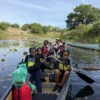
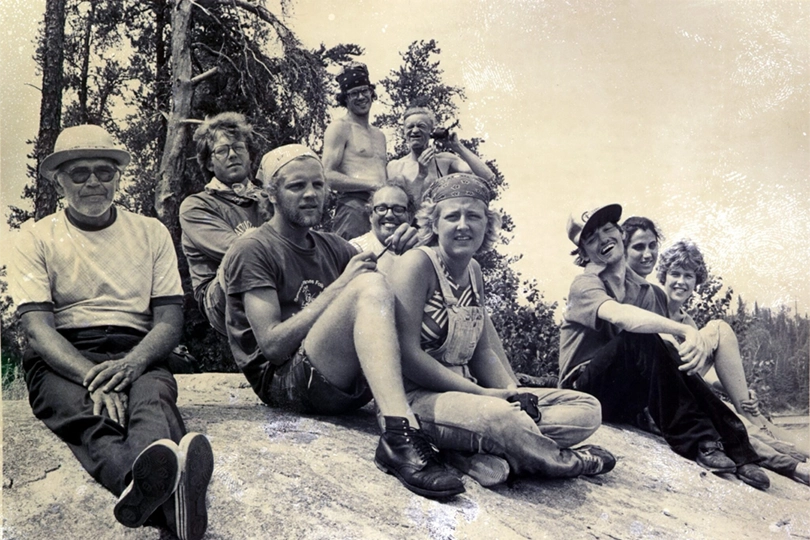
On a gray May morning in 1977, a small group of strangers pushed canoes off a rocky shore in the Boundary Waters Canoe Area (BWCA) Wilderness and pointed their bows toward Lac La Croix. The sky hung low. Rain drifted in and out. The wind did that Boundary Waters thing where it never quite seems to be at your back.
By most measures, it was an ordinary BWCA morning: jack pines leaning into the shore, loons calling from somewhere you couldn’t quite see, granite worn smooth by a thousand years of water and ice. But for our community of supporters, that day was anything but ordinary. It quietly set in motion what would eventually become a movement—welcoming over 750,000 people from all walks of life into the outdoors.
People had been fighting about this place. In policy hearings and on editorial pages, some claimed that restricting motorboat access would make the Boundary Waters off-limits to “the handicapped, elderly, and women.” In other words: if we protected the wilderness, we would exclude the people.
That argument struck a nerve. Greg heard it and refused to let it pass unchallenged. “Why don’t you prove them wrong?” his sister Mary asked. So, we did.
A Wild Idea, a Headwind, and a New Definition of “Possible”
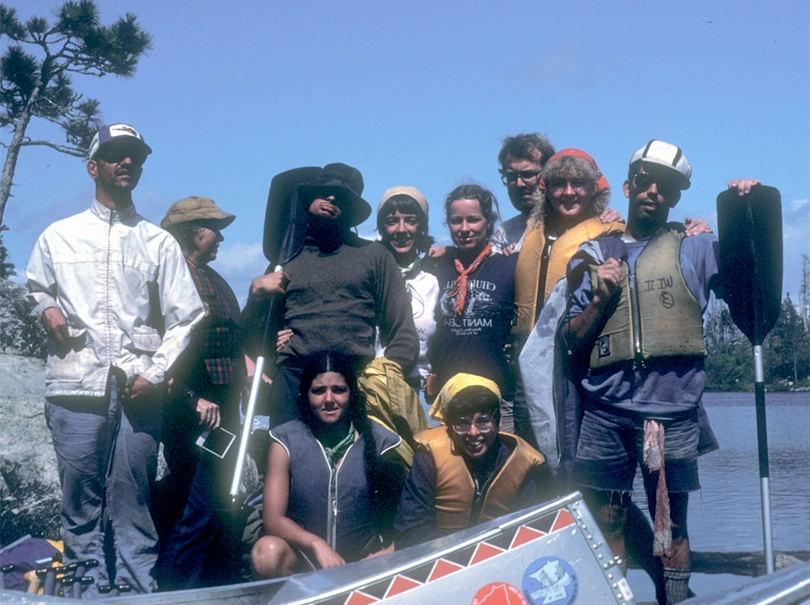
Building on early experiences with his mentor, Bill Simpson, Greg teamed up with his college friend and fellow adventurer, Paul Schurke, and organized a canoe trip that, at the time, felt radical: a journey into the Boundary Waters designed to include the very people policymakers said couldn’t be there. With Mary’s help, we recruited a small, mixed-ability crew:
- Two people who were deaf
- Two people with paraplegia
- Two other paddlers with different abilities and experiences
Together, the group paddled into the Lac La Croix region—a labyrinth of glassy lakes, narrow channels, and portage trails that wound through white pine, spruce, and birch. On a calm day, the area is all glittering reflections and distant loon calls. On a stormy one, it can feel like the whole sky is being poured into your canoe.
That 1977 trip was not curated as an easy introduction. It was the Boundary Waters in full force: pouring rain, lasting headwinds, and some long, uneven trails where progress was measured in feet, not miles.
Out there, the wilderness did what wilderness does best: it ignores labels we impose on ourselves and each other.
No one asked who was “able-bodied” when the storm rolled over the lake. What mattered was who would paddle, who would steady the canoe at the landing, and who would share a joke when everyone was soaked and tired.
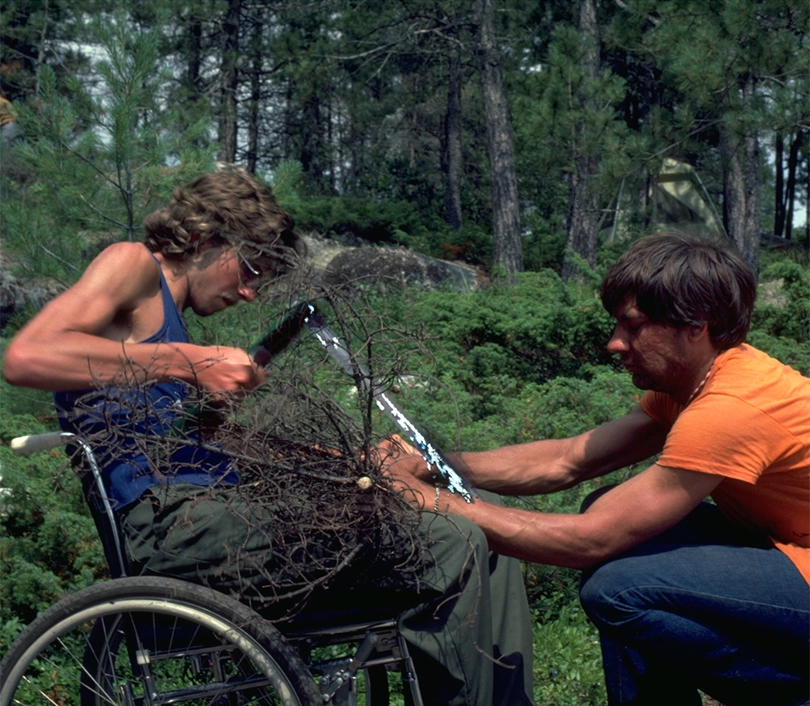
Greg watched one participant, Margot Imdeike, crawl across a portage trail, dragging her wheelchair behind her. For Margot, it was pure grit: she had decided that the trail would not be the final word on where she belonged. In that moment—and in a hundred others like it—that trip revealed a truth we’ve been living into ever since:
When you share real challenges in wild places, you start to see each other as human beings first.
Conventional wisdom said the Boundary Waters was too rugged for many people. That canoe trip proved the problem wasn’t the wilderness—it was our assumptions. The real question wasn’t “who can handle this place?” but “how do we create outdoor experiences so everyone can participate as equals?”
That question has guided Wilderness Inquiry for 48 years.
From One Bold Trip to a Movement
The success of that first journey didn’t just settle an argument—it lit a fuse. In 1978, we incorporated Wilderness Inquiry as a nonprofit organization grounded in a simple, radical idea:
The outdoors should be for everyone, not just those who fit a narrow mold of who “belongs” in wild places.
Even our name carries that intention:
- “Wilderness” is our magnificent setting—the lakes, rivers, forests, and prairies that open minds to possibility.
- “Inquiry” is the mindset—curiosity, exploration, and the willingness to question our assumptions about ourselves and each other.
Over the years, Wilderness Inquiry diversified. Rather than one single “type” of trip, we built programs for different communities: people with and without disabilities, families, youth who never had an opportunity to go backcountry, adults with developmental disabilities, and more.
The details of those early programs matter less than the pattern they established: from the beginning, Wilderness Inquiry was intentionally reaching across age, ability, background, and circumstance. Our trips were never about serving one narrow slice of the public; they were about opening doors for people who had been told, explicitly or implicitly, that the outdoors wasn’t for them. We sought to include outdoor adventure as a normal part of life for everyone, not just a select few.
Long before “access,” “inclusion,” and “belonging” became common language in the outdoor world, Wilderness Inquiry was building trips where those values were the starting point—not an add-on.
The Numbers Tell a Story—But Not the Whole Story
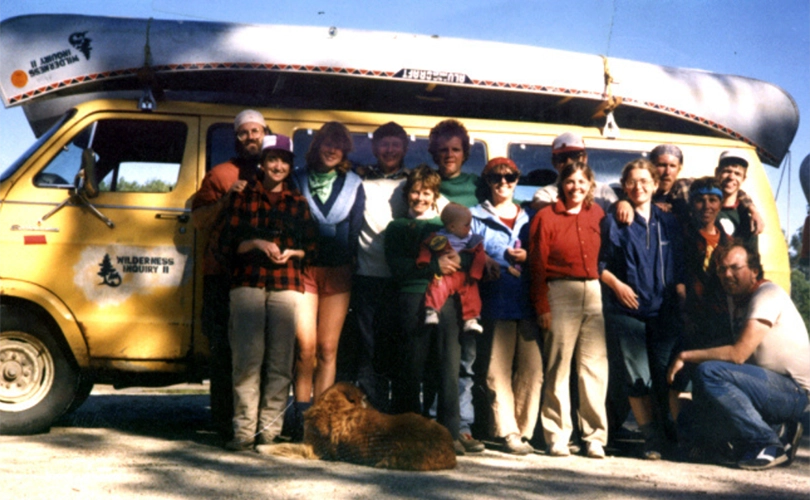
As we mark our 48th anniversary on May 4th, our canoes are still on the water. The portages are still muddy. The shared laughter around the campfire is as warm and welcoming as ever. What has changed since 1978 is the scale. What began with a single Boundary Waters trip has grown into a nationwide movement.
In 2025, 40,000 people from all walks of life adventured with Wilderness Inquiry:
- 38,312 youth, families, and community members paddled, learned, and explored the outdoors with us through Canoemobile and day programs—from San Francisco to Norfolk.
- 1,970 individuals and families joined extended and near-nature adventures, camping and exploring along rivers, mountains, and sea caves.
- 403 individuals participated in leadership and career pathways, building outdoor and professional skills that open doors in the outdoor industry.
We now camp, hike, and paddle across more than 20 destinations and 80 communities every year. No one questions whether the “handicapped, elderly, or women” can participate anymore. Can you even imagine someone making the comment? While these numbers are meaningful, the real impact lives in the quieter, personal shifts we’ve both had the privilege to witness repeatedly.
Confidence & Personal Growth
Nature has a way of inviting us to test the edges of what we think we can do. On a windy lake crossing, during a first night away from home, or on a trail that seems longer than you remembered from the map, you start to renegotiate your own limits.
Over the years, we’ve seen:
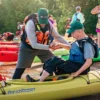
- An adult who uses a wheelchair navigate a rocky shoreline—and then turn around to help someone else make the same crossing.
- A middle schooler from the city, who had never been in a canoe or worn a lifejacket before, beam at the end of a day on the water: “I didn’t know I could do this.”
- The parents of a child with cerebral palsy discover that their daughter could make friends and thrive on a trip to a National Park.
- A 42-year-old architect without a disability discover that his kayak partner with paraplegia could paddle better than he could.
These moments aren’t about conquering the wilderness. They’re about discovering that together, we are capable of far more than we imagined.
Community & Belonging
Where we go matters. But who we go with is everything. For Wilderness Inquiry, the diversity of our participants is intentional—it makes our trips far more interesting and engaging. On every Wilderness Inquiry trip, the group itself is the heart of the experience. When you share a canoe, a camp kitchen, a trail, or a starry sky, something shifts in how you see yourself and others. Out here, there is no “back row.” Everyone matters. Everyone brings their special gifts to the experience.
Inclusion Without Barriers
We believe every person deserves access to the physical, mental, emotional, and social benefits that time outdoors can offer. People are part of all natural systems—not separate from them. We don’t pretend the barriers don’t exist. We name them. Then we work to overcome them.
The Boundary Waters: Then and Now
So much of this began in the Boundary Waters Canoe Area Wilderness—a place of granite outcrops and quiet bays, of white pine silhouettes and pink-and-gold sunsets, of loons, northern lights, and the kind of silence that settles into your bones.
When that first Wilderness Inquiry crew paddled into Lac La Croix in 1977, the BWCA was at the center of fierce public debate. People were asking:
- Who gets to decide how this place is used?
- Can we protect its wild character without shutting people out?
- Do we really believe that everyone deserves a relationship with a place like this?
Those questions helped shape our identity. Our answer—then and now—has been a steady, “Yes. Everyone Belongs.” Yes, we can protect wild places and invite people in to experience them in gentle ways. Yes, we can provide trips where people with and without disabilities share the same campfire, canoes, and the same sense of accomplishment. Yes, we can hold the Boundary Waters as a treasured, fragile landscape while insisting that its gifts not be reserved for a select few.
When more people have meaningful, supported experiences in places like the Boundary Waters, we build the broad, lasting care needed to protect them. Every young person who feels the lift of a canoe on a northern lake, every family who sees the Milky Way reflected on calm water, every participant who surprises themselves on a portage—each one carries a piece of this special place home. And we’ve learned, again and again: people fight for what they love.
Looking Back with Gratitude, Looking Forward with Resolve
Forty-eight years is a long time in the life of an organization, but only a heartbeat in the life of a wilderness. As we mark this anniversary together, we are filled with gratitude:
- For the thousands of people who have trusted us enough to step into a canoe, onto a trail, or into a new experience with Wilderness Inquiry
- For the staff, trip leaders, educators, and partners who pour their skill and heart into making “outdoors for all” a daily, lived reality
- For early advocates, like Margot, Paul, and Bill and so many others, whose determination continues to shape how we think about ability, leadership, and belonging outdoors
Too many people still haven’t had the chance to sleep under the stars, hear a loon at night, or feel the kind of tired that only comes after a full day outside. Too many barriers—economic, physical, cultural, systemic—still stand between communities and the lands and waters that are, by right, theirs.
Our response, now as in 1977, is to keep doing what we do best:
- Bringing more people outside, together
- Providing trips that include everyone
- Building pathways into leadership and outdoor careers
- Working with communities and partners working to make outdoor spaces more welcoming, more accessible, and more deeply valued by all
One canoe trip in 1977 helped change the conversation about who belongs in the Boundary Waters. Forty-eight years later, 750,000 people have paddled, hiked, and grown with Wilderness Inquiry in wild and near-nature spaces across the country.
The scale has grown. The geography has expanded. The tools have improved. But the core belief we share remains the same:
When we venture into nature together—across differences, across perceived limits—we don’t just explore a place. We discover what’s possible for all of us.
Thank you for being part of this journey. We’re honored to celebrate 48 years with you, and we’re looking forward to what the next 48 could hold.
If you’d like to dive deeper into how a single Boundary Waters trip became a nearly five-decade movement, you can explore our full history here.
Erika Rivers has been the Executive Director of Wilderness Inquiry since 2021. Prior to that, she was the Director of Minnesota State Parks and Trails, where she championed accessibility within the system. Greg Lais is the Founder of Wilderness Inquiry and served as its Executive Director for 42 years.
photos: Julie Corty, Greg Lais, Nora West, Callianne Jones, Ryan Brady, and Corrina Stadler